How Your Brain and Fingers Work Together
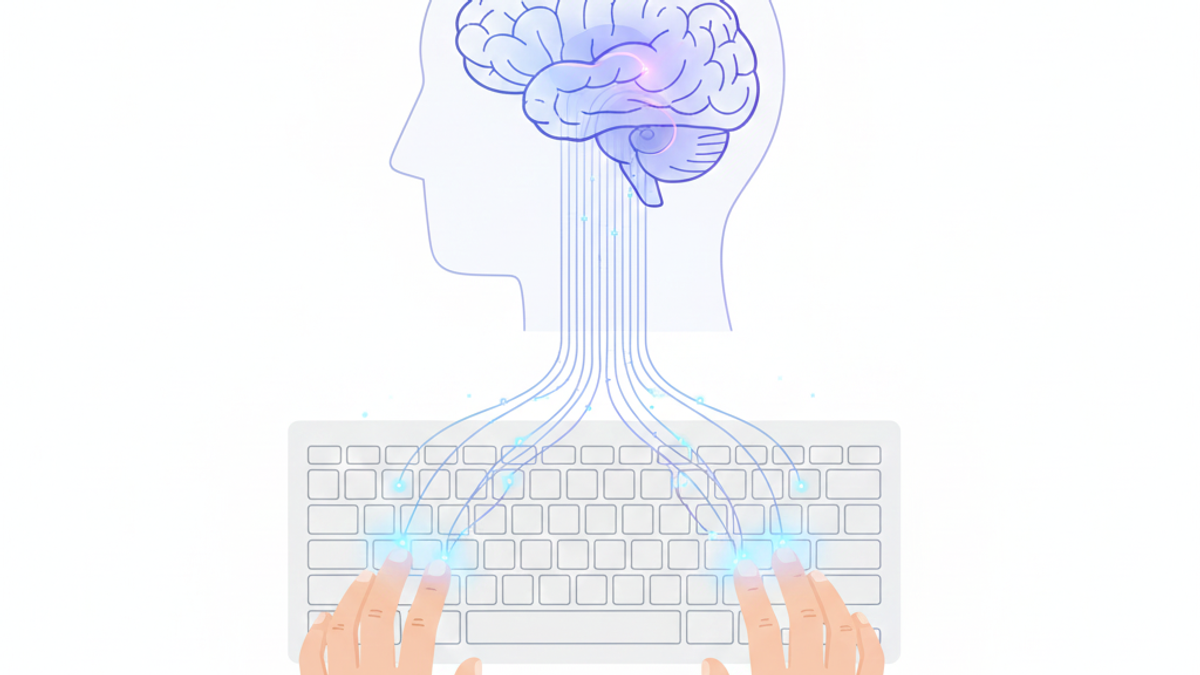
1. How Your Brain Processes Typing
When you type, your brain performs multiple steps within milliseconds.
Step 1 — Concept Formation
You decide what you want to say. This process happens in the prefrontal cortex, where ideas are formed.
Step 2 — Language Processing
Areas like Broca’s area and Wernicke’s area convert those ideas into words, grammar, and sentence structure.
Step 3 — Motor Planning
Your brain plans precise finger movements using the motor cortex.
It decides:
- Which finger will press each key
- The order of movements
- The timing between keystrokes
This is similar to how the brain handles playing an instrument.
Step 4 — Neural Transmission
Signals travel through your nerves at nearly 120 meters per second to your hands.
Step 5 — Execution
Your fingers move.
Your eyes track the result on screen.
Your brain adjusts your speed, accuracy, and rhythm in real time.
Typing is basically a small-scale “neuroscience miracle.”
2. Muscle Memory: Your Biggest Typing Advantage
When you practice typing repeatedly, your brain builds a map called a motor pattern.
This is why:
- You can type without looking
- You can type quickly even when thinking about something else
- You can recover from mistakes immediately
Your fingers start “remembering” key positions.
Muscle memory grows stronger by:
- Repetition
- Accuracy training
- Using all fingers (touch typing)
- Maintaining consistent hand positioning
This is why beginners type slowly—they rely heavily on conscious thinking.
Experts type subconsciously using muscle memory.
3. Reaction Time Matters
Faster typists often have shorter reaction times.
When you see a letter on screen:
- Your visual cortex identifies the character
- Your brain matches it to the correct finger
- Your muscles trigger the movement
Good typists reduce the delay between these steps.
How to improve your reaction time:
- Practice typing tests daily
- Train with random word generators
- Improve focus
- Avoid multitasking while typing
4. Hand–Eye Coordination and Typing
Your brain constantly synchronizes:
- What your eyes see
- What your fingers do
- What your memory recalls
This is why touch typists can type faster without looking at the keyboard — they free their eyes to focus on content, not keys.
5. How This Science Helps You Type Faster
Understanding the process helps you train smarter:
Build muscle memory
Use all fingers. Avoid peeking at the keyboard.
Keep consistent form
Correct posture reduces brain fatigue and improves accuracy.
Train with repetition
Your motor cortex strengthens with repeated patterns.
Remove distractions
Typing is a high-speed brain function — multitasking slows the neural loop.
Practice daily
Even 10 minutes a day reinforces neural pathways.
Final Thoughts
Typing is more than just tapping keys — it is a remarkable coordination of memory, motor skills, neural signaling, and decision-making.
The more you understand how typing works, the better you can train your brain and fingers to work at maximum speed and efficiency.